
You’re lucky, very lucky. Lucky that I was not the first person on earth. If I had been, there would be no coffee and no bread.
For an entire lifetime I could look at a coffeeberry or stalk of wheat and never see breakfast of coffee and toast. Never.
Today I can be a connoisseur of both and feel like I know all about them, like I created them. But I know it never would have happened.
Likewise, while I can admire the genius of current digital inventions, they are entirely dependent upon practical uses of electricity that were developed long ago. And plastic. And much else.
American culture reveres the “lone” cowboy, hero, or genius who, like politicians, take credit for the whole without acknowledging precedents, tax breaks, and social systems that open their paths while those same precedents can also close the paths of others.
Which brings us to Artificial Intelligence or AI which you will hear about every day now. And why? AI learns and it learned to repeat itself.
What is it repeating?
Thoughts
Eastern culture has a practice of meditation with one exercise involving the examination of thoughts. Not where thoughts lead, but thoughts themselves. Not solving a problem but watching the mind that is trying to solve a problem.
Western culture does not have this practice and it’s a wonderful time to learn as AI is selling our thoughts back to us. Our thoughts, posted in countless forms digitally, is the food of AI. And those thoughts are our minds.
The “mind” in Western culture is simply the brain and its impulses. In Eastern thought, it’s a sense and the “objects of thought” a sixth sense – not telepathy – but manifested life.
We are experiencing our thoughts.
This sounds philosophical but it’s occurring in a more obvious fashion than in the past where we simply move along the path of stimulation, experience, and reaction.
Our thoughts and experiences are now for sale – to us.
Mercury
The planet Mercury in astrology traditionally represents communication, daily interactions, stimulation, and learning.
The glyph for Mercury is a circle (spirit) with the moon on top (mind) and a cross below (matter). Spirit, then, is sandwiched between mind and matter.
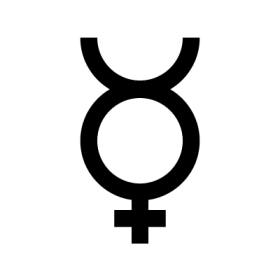
More than communication, Mercury is our experience of reality. Our thoughts on top start the experience which then becomes matter on the bottom. Our spirit is, let’s say, the slice of turkey between two slices of bread.
The top slice is the image and form of the sandwich. The bottom slice is the foundation keeping the sandwich together. Our sun sign is the turkey. Or ham. Or peanut butter.
Our moon sign forms the experience. Our Saturn solidifies it.
Uranus in Gemini
Mercury rules Gemini which represents our youth, especially teenage years, when learning and experiencing are most important as the growth that leads to the mature individual. What is not learned during this stage of development – such as a foreign language – becomes difficult to learn later in adulthood.
Uranus has recently entered Gemini for a seven-year stint. Leaving the fixed earth sign Taurus, you may have noticed how things have sped up from pandemic “shelter-in-place” to “now” – oh, sorry, you just missed now. It comes again in five minutes.
Uranus is enlightenment, ultimately, clarity. As noted in other blogs, enlightenment and clarity is sometimes refreshing (I figured out how to get rid of my acid reflux!) or devasting (I figured out that my spouse is not in Kansas City at a conference but in Las Vegas with a lover!).
It’s time to be enlightened about our thoughts. Or devasted by them.
Fears of AI
Our fears of AI taking over our lives, then, is fear of our own minds. We’ve already taken over our own lives with our thoughts.
The question then becomes, whose thoughts?
American culture is based on individuality and freedom. Feeling “unique” is an American characteristic, ironically, that we share. So, we all feel “unique” which means we all have learned to feel this way.
Is that thought our own?
When someone says, “That’s just how I was raised,” or “In my culture we do this,” they are saying, “I learned my thoughts.” Most practice the religions in which they were raised (and sometimes we have no choice).
Those that feel different than their family or culture, then, are most likely to venture out into their own thoughts, to examine, for example, why they are supposed to like the opposite gender but prefer their own gender.
A colleague of mine feared we’d all be equally smart with AI, all equal; my response is that when you scratch the surface, you can see what we really know. And if the electricity gets cut off, then we’ll surely know.
Equality, though, sounds nice.
Which thoughts are truly ours, developed by us, over time and contemplation?
AI, for sure, has created confidence in our positions whether fully understood or quickly gathered from videos and memes. But are these our thoughts?
The actor of your thoughts
In the British series Mum season three, last episode, there is a kitchen scene with “mum” making an hors d’oeuvre for a party while talking to her son. For a moment we think they are arriving, finally, at common understanding having experienced a very touching scene in the prior episode.
That, unfortunately, does not occur as this show mirrors the reality that folks don’t suddenly awaken and change. In addition to that, the son grabs a couple of hors d’oeuvres, a pet peeve so irritating to mum and to this viewer.
The actor playing the son, then, must understand that this action is obnoxious or irritating to certain people who will be watching. This simple act represents his ongoing lack of maturity and understanding of the needs and efforts of others.
The actor, then, is more mature, or at least gets insight into the fact that this can be inconsiderate to others.
When we have thoughts or use AI, are we like the actor understanding the meaning of the action or like the character that is experiencing the action?
With our thoughts – called “AI” now – will we be the actor or the character?
If we are so afraid of our thoughts, can we be the actor and change them?


Our library offered a workshop on “the dark side of AI”. The instructor brought up the environmental impact as well as a new generation that might not ever learn to think. You go deeper in this article with the particular American characteristic of valuing our uniqueness. Could this make us more inclined to not even realize where our “thoughts” are coming from?
As a country we seem to have an extroverted personality/culture. I believe that makes us less self-reflective. Maybe these changing times will alter that, a phase of maturity, “sadder but wiser.”
With Uranus in Gemini, I have crossed the last quarter of the Uranian cycle.
Based on last post, in 3rd house? Learning for enlightenment? Retire in a unique and quirky place by the water when it’s in Cancer?
The Uranus cycle is 84 years, so experiencing the last quarter phase before its return to its natal position…